


When your internet goes down, your VoIP phones stop working, or a critical software platform suddenly stops syncing, who owns the problem?
For many organizations, the answer is unclear. You’re left acting as the middleman between your internet provider, phone vendor, and software companies - relaying messages, opening tickets, and trying to determine who’s responsible.
A properly structured managed IT relationship should eliminate that confusion.
Vendor management is one of the most overlooked, and most valuable, components of managed IT services. Done correctly, it means your IT provider takes ownership of vendor coordination, escalation, oversight, and performance so you don’t have to.
Here’s what that should actually look like.
1. A Single Point of Accountability
Fragmented accountability creates operational risk.
If your internet provider blames your firewall, your VoIP vendor blames your network, and your software vendor says “everything looks fine on our end,” progress stalls.
A strong managed IT provider should:
-
Act as the primary technical contact for all IT-related vendors
-
Open and manage support tickets on your behalf
-
Escalate issues through proper vendor channels
-
Coordinate multi-vendor troubleshooting calls
-
Document outages and resolution timelines
Instead of being caught between companies, you have one team advocating for you and driving resolution.
2. Internet Service Provider (ISP) Coordination
Internet reliability underpins nearly every modern organization - cloud applications, VoIP phones, remote access, and cybersecurity protections all depend on it.
Vendor management should include:
-
Reviewing internet contracts prior to renewal
-
Monitoring circuit performance and uptime
-
Escalating outages directly with the ISP
-
Verifying SLA compliance
-
Managing bandwidth upgrades as your organization grows
-
Evaluating failover or secondary internet options
Internet and telecom providers in Canada operate within regulatory frameworks overseen by the CRTC, and understanding those service obligations helps ensure outages, billing disputes, and contract terms are handled properly. A mature IT partner doesn’t simply “call the ISP.” They understand your network architecture and can determine whether the issue lies with the provider, internal infrastructure, or configuration changes — and escalate accordingly.
3. VoIP & Telecom Oversight
Business phone systems are fully dependent on network stability and proper configuration.
Proper oversight includes:
-
Coordinating with VoIP vendors during service disruptions
-
Troubleshooting call quality issues (latency, jitter, packet loss)
-
Validating Quality of Service (QoS) configuration
-
Tracking hardware lifecycle and warranty status
-
Reviewing telecom contracts before renewal
Many providers install a phone system and step away. Comprehensive managed IT services should involve ongoing monitoring of the infrastructure that supports your business.
4. Software & Cloud Vendor Coordination
Today’s organizations rely on dozens of cloud and software vendors - Microsoft 365, accounting platforms, CRM systems, industry-specific tools, and security platforms. Vendor management should extend beyond troubleshooting.
A capable IT partner should:
-
Manage licensing and user access
-
Review license utilization before renewals
-
Identify unused or redundant subscriptions
-
Coordinate escalations for service issues
-
Oversee integrations between systems
-
Validate security configurations
Without structured oversight, organizations often overpay for unused licenses or miss renewal timelines that trigger automatic price increases.
5. Vendor Risk & Security Vetting
Vendor coordination isn’t only about functionality... It’s also about risk management.
Every internet provider, VoIP platform, and SaaS vendor introduces operational and security dependencies. A managed IT provider should evaluate those relationships carefully.
That includes:
-
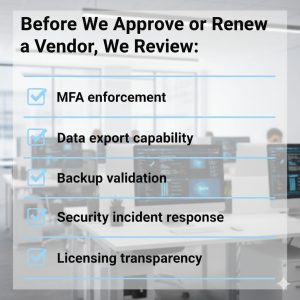
Reviewing vendor security controls (MFA, encryption, access logging)
-
Confirming backup and data recovery capabilities
-
Understanding data residency implications
-
Validating account ownership and administrative access structure
-
Reviewing vendor incident response processes
-
Assessing contractual exit terms and data portability
Before recommending or renewing a software platform, a responsible IT partner should evaluate how user access is provisioned, how data can be exported if you terminate the contract, and how the vendor handles breach notification.
Vendor relationships are strategic decisions, not just technical integrations.
6. Contract & Renewal Oversight
Vendor relationships evolve over time. Contracts renew, pricing changes, and service quality can shift.
Structured oversight should include:
-
Maintaining documentation of vendor contracts
-
Tracking renewal dates
-
Reviewing service performance annually
-
Identifying cost optimization opportunities
-
Evaluating alternatives when appropriate
This transforms IT from reactive troubleshooting into proactive operational management.
What Vendor Accountability Looks Like in Practice
Vendor management becomes most visible during real-world disruptions.
Scenario 1: Midday Internet Outage
At 10:15 AM, cloud applications become unreachable and phones begin dropping calls.
Instead of being told to contact your ISP, your IT provider:
-
Confirms internal network and firewall status within minutes
-
Identifies the external circuit as the failure point
-
Opens a priority ticket directly with the ISP
-
Escalates beyond frontline support if response times stall
-
Documents outage start time for SLA validation
-
Provides leadership with structured status updates
-
Confirms service stability before closing the incident
You’re not coordinating between vendors. Instead, your IT partner is driving resolution.
Scenario 2: VoIP Vendor Blames Bandwidth
Your phone provider claims call quality issues are bandwidth-related. The internet provider insists the connection is stable.
A structured response includes:
-
Reviewing network monitoring data (latency, jitter, packet loss)
-
Validating firewall QoS configuration
-
Conducting targeted testing if required
-
Coordinating a joint troubleshooting session between vendors
-
Identifying the root cause rather than accepting finger-pointing
Technical validation replaces guesswork.
Scenario 3: SaaS Licensing Auto-Renews at Higher Cost
A software platform auto-renews at a higher tier, increasing your annual invoice significantly.
Vendor oversight includes:
-
Reviewing renewal notices before processing
-
Auditing feature usage across users
-
Adjusting licensing tiers to match operational needs
-
Addressing unexpected pricing changes with the vendor
This protects your IT budget from unnecessary escalation.
Scenario 4: Vendor Security Incident
A SaaS provider issues a breach notification.
Your IT provider:
-
Reviews the scope of exposure
-
Assesses potential impact within your environment
-
Enforces credential resets if required
-
Validates MFA enforcement
-
Documents remediation actions
Vendor incidents are managed methodically, not reactively. If the incident meets reporting thresholds, we also guide organizations through breach notification obligations in accordance with requirements set by the Office of the Privacy Commissioner of Canada.
How Cypher Systems Handles Vendor Management for Our Managed IT Services Clients in Ottawa
As part of our managed IT services in Ottawa, Cypher Systems acts as your single point of coordination across internet providers, VoIP vendors, cloud platforms, and software providers.
We:
-
Manage vendor communications and escalations
-
Track renewals and contract timelines
-
Review performance and cost alignment
-
Evaluate security posture and risk exposure
-
Align vendor decisions with your long-term IT roadmap
Our goal is simple: your organization should never be caught between vendors trying to determine responsibility.
We take ownership so you can focus on running your organization. If you’re unsure whether your current IT provider is actively managing your vendor relationships, we’re happy to review them with you. Give us a call at (800) 864-2797 or fill out the form to the right.

Gabriel Rapacz
He believes IT is ultimately about supporting people, not just technology. Gabriel focuses on making systems approachable and effective for each client and their team, adapting to different levels of comfort and experience.
With a strong interest in cybersecurity, Gabriel stays current on emerging threats and attacker tactics, helping clients stay protected in an evolving landscape.